


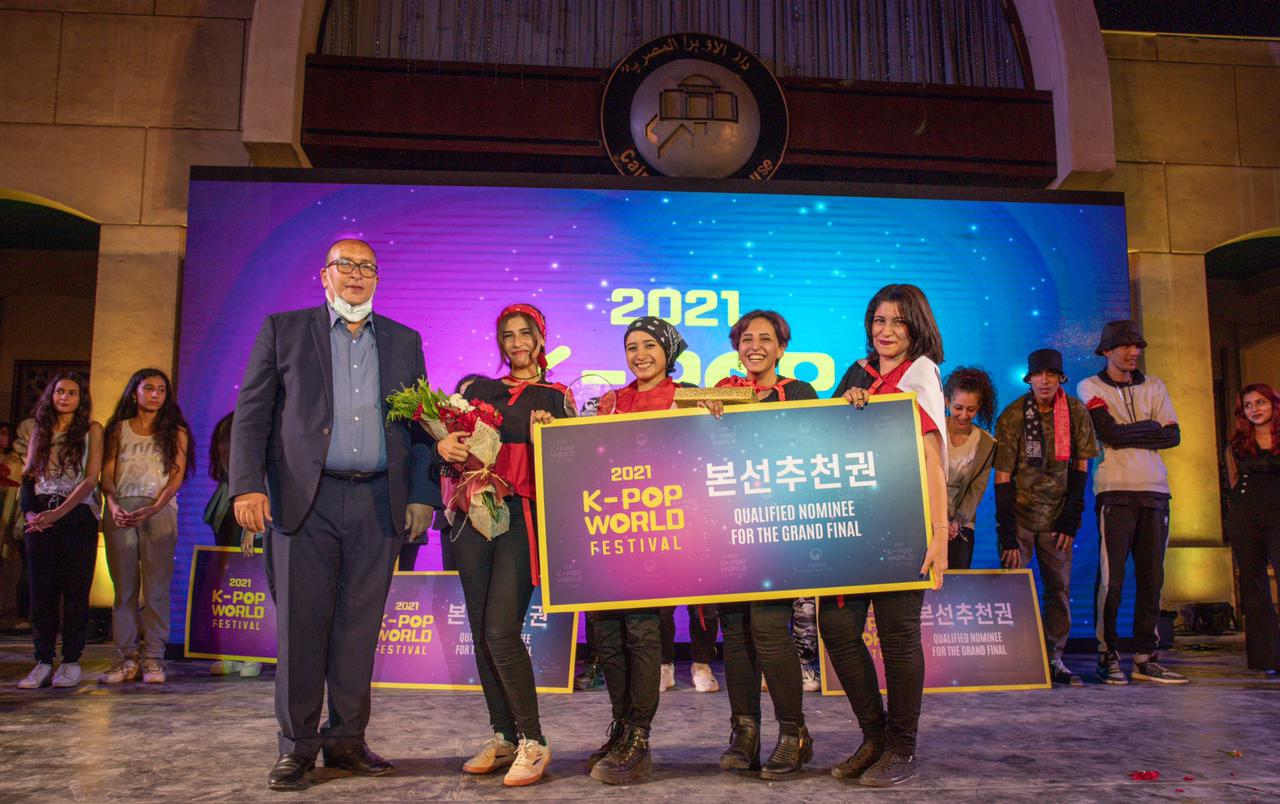
Young Egyptians nowadays rehearse synchronized dance routines to songs by BLACKPINK, a South Korean girl group, or BTS, a South Korean boy band —groups they have never seen in concert, in a language most of them do not understand. They film themselves and post the clips online to engage with like-minded fans. For a fast-growing slice of Egyptian youth caught up in Hallyu, or the Korean cultural wave, that cultural phenomenon shapes how they listen, dress, and dream.
What began as a niche curiosity, a few young Egyptians stumbling onto Korean dramas and music in the 2000s, has since exploded into a mainstream cultural force. Today, countless members of Egyptian youth are part of online K-pop communities, where being a fan is about identity and less about passive consumption.
Since the early 2010s, the spread of K-dramas and K-pop has been boosted by streaming platforms and social media and has turned it into a widespread cultural phenomenon, particularly among university students. Korean content is now widely consumed in Egypt through Netflix, YouTube, and dedicated fan communities on Facebook and Instagram. As of 2020, Egypt recorded a 33 percent increase in K-Pop music streaming, according to a Spotify statement.
Much of the appeal lies in the content itself. High production value, emotional storytelling, and a strong, organized online fan presence have all contributed to K-pop’s hold on Egyptian audiences, especially young women. The number of Egyptian students choosing to study the Korean language has significantly increased over the past few years, a sign that for many, the interest goes well beyond music.
Now that grassroots enthusiasm is gaining an institutional foothold.
In 2014, the Korean Cultural Center (KCC) in Cairo was launched under South Korea’s Ministry of Culture, Sports and Tourism, and has formalized what fans have long been doing on their own. It offers Korean language classes, film screenings, exhibitions, traditional arts workshops, and cultural festivals to bring Egyptian enthusiasts closer to aspects of Korean life that remain less visible than the pop charts.
In 2022, the KCC launched its K-Pop Academy at the Ballet Institute affiliated with Egypt’s Academy of Arts, offering structured training in K-pop dance. Notably, the instructors were not flown in from South Korea; they were Egyptian winners of a K-pop competition held by the center itself.
In 2022, the KCC also introduced a curriculum for Gugak, Korean traditional music, holding a two-week lecture for 40 participants. At the closing ceremony held at the Egyptian National Academy of Arts, graduates wore traditional Korean performance costumes and showed their skills learned over two weeks of intensive study, part of a broader effort to introduce audiences in Egypt to the classical roots of a culture they had come to know largely through its contemporary exports.
The infrastructure of the Korean cultural wave in Egypt is trying to catch up to passion, but the fans came first, teaching themselves dances from YouTube tutorials, forming online communities, organizing screenings and meetups with little institutional support. The academies, the formal training programs, and the cultural diplomacy came after, building on what was already alive. For a community that never needed an institution, whether that formalization deepens the culture or dilutes it is for the Egyptian fans is still to be unfolded.




Comments (0)